



You invested in a premium pair of wireless earphones—yet the sound still feels less detailed than wired.
Or maybe you notice a slight delay when watching videos.
The reason often comes down to one critical but overlooked factor: audio codecs.
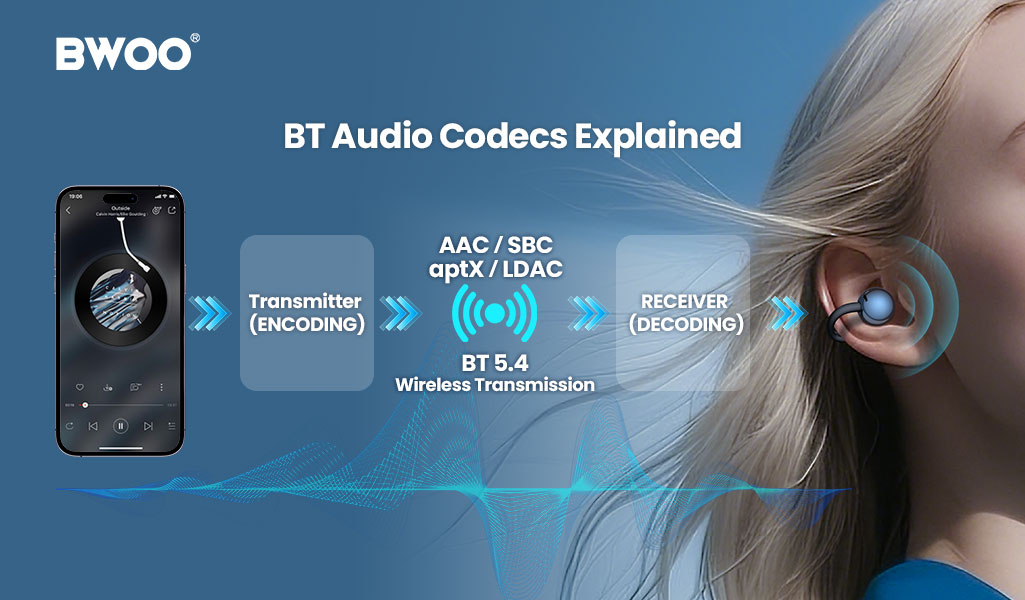
In wireless audio systems, a codec acts as a "translator." It determines how sound is compressed, transmitted, and reconstructed—directly affecting sound quality, latency, and connection stability.
1. Codec Basics: How Wireless Audio Transmission Works
Raw audio data is extremely large and cannot be sent directly over limited wireless bandwidth.
Instead, all wireless audio follows the same three-step process:
Encode (Compression) → Transmit → Decode (Reconstruction)
Three key technical metrics define a codec's performance:
Bitrate: Data transmitted per second (higher usually means better sound detail)
Sampling Rate: How frequently sound is captured
Latency: The time delay between sound generation and playback
2. Codec Comparison: SBC vs AAC vs aptX vs LDAC
SBC — The Universal Foundation
What it is:
The baseline codec required for all BT wireless audio devices.
Pros & Cons:
Maximum compatibility, but heavy compression results in limited detail and higher latency.
Best for:
Voice calls, podcasts, basic listening.
AAC — Optimized for Apple Ecosystems
What it is:
A more efficient codec widely used on Apple devices.
Pros & Cons:
Excellent performance on iOS; inconsistent results on some Android platforms.
Best for:
iPhone users and mainstream music streaming services.
aptX Family — Performance-Oriented Wireless Audio
What it is:
A codec family designed for improved sound quality and reduced latency.
aptX: Balanced upgrade over SBC
aptX HD: Higher-resolution audio
aptX Adaptive: Dynamically balances latency and quality
Pros & Cons:
Strong performance for gaming and video, but requires compatible hardware on both ends.
Best for:
Android flagship phones, gamers, multimedia users.
LDAC — The Wireless Audio Quality Ceiling
What it is:
A high-bitrate codec developed for near-lossless wireless audio, supporting up to 990 kbps.
Pros & Cons:
Certified for Hi-Res Wireless audio; requires excellent signal stability.
Best for:
Audiophiles and lossless music collectors.
3. How Codecs Shape Real-World Listening
Sound Quality
Higher bitrate codecs preserve more texture, depth, and spatial detail.
Latency
For gaming and video playback, codecs such as aptX Adaptive or next-generation BT 5.4 low-latency audio significantly reduce audio delay.
Stability
Higher bitrates demand stronger connections.
Dense environments may challenge codecs like LDAC without proper hardware tuning.
4. BWOO's Audio Approach: Hardware and Codec Optimization
Full Codec Compatibility
BWOO's high-end wireless audio lineup—including the 2026 TWS Hi-Fi series—supports advanced codecs such as LDAC and aptX, enabling high-resolution wireless playback.
Acoustic-Level Signal Optimization
Codec support alone is not enough.
BWOO fine-tunes internal DAC (Digital-to-Analog Converter) circuits to minimize distortion during signal reconstruction.
Wireless 5.4 & LE Audio Roadmap
BWOO is actively expanding support for LE Audio and LC3, delivering improved sound quality with lower power consumption for next-generation wireless ecosystems.
5. Conclusion: No "Best" Codec—Only the Right Match
There is no universally perfect wireless audio codec.
A codec only delivers its benefits when both the source device and the earphones support the same standard.
The right pairing unlocks the full potential of wireless sound.
Looking to experience true high-resolution wireless audio?
Explore BWOO's 2026 Hi-Fi earphone lineup—engineered for advanced codecs, not marketing shortcuts.


