



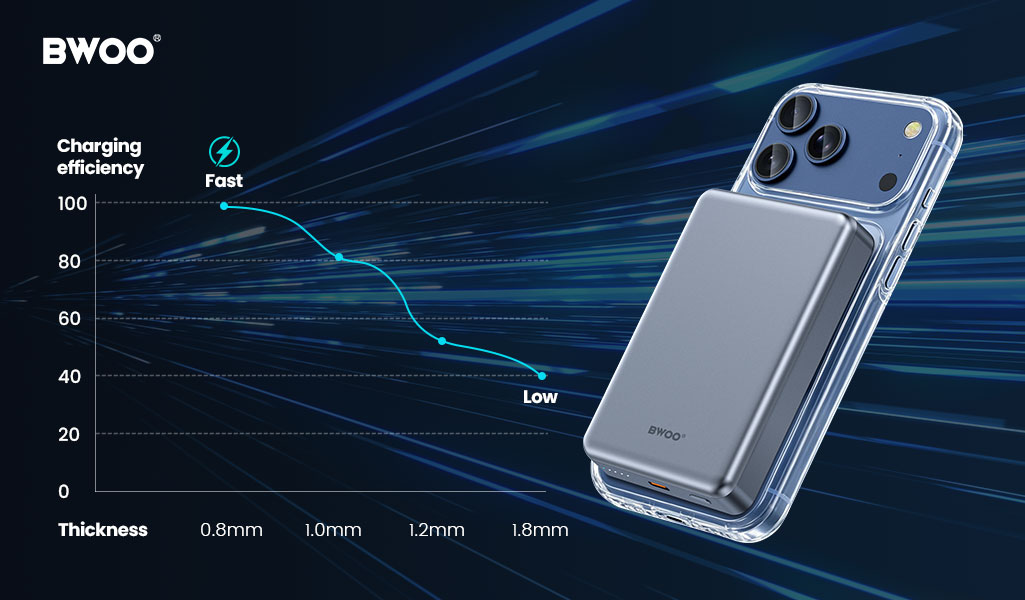
You bought a Qi2.2 magnetic wireless charger, placed your phone on it, and... nothing. Or worse: it says 'charging' but your battery percentage barely moves after 30 minutes. Before you return the charger, check your phone case. The thickness and material of the case between your phone and the charger may be the single most overlooked variable in wireless charging performance.
The Physics: Understanding the "5mm Rule"
Wireless charging works via electromagnetic induction: an alternating current in the charger's transmitter coil creates a magnetic field, which induces a current in the receiver coil inside your phone. The strength of this magnetic field decays with distance — specifically, it follows an inverse-square relationship. Every millimeter of distance between the two coils reduces power transfer efficiency and, critically, the maximum power the receiver can draw.
The wireless power industry has a practical heuristic known as the '5mm Rule': the total gap between charger coil and phone coil should not exceed 5mm for optimal performance. This gap includes the charger's own housing (typically 0.5-1.0mm), the phone's back glass (0.5-1.0mm), and — crucially — your phone case. If your case is 3mm thick, you are already at the edge. At 4mm+, you have likely exceeded the optimal gap and will experience reduced charging speeds, intermittent connection, or complete failure to charge.
Case Thickness vs. Charging Performance: The Data
Case Thickness | Charging Efficiency | Max Achievable Power (25W Qi2.2) | 30-Min Charge (iPhone 16 Pro) | Magnetic Hold Strength |
No case (direct contact) | 87% | 25W | +55% | Full (≥800gf) |
≤1.5mm (thin TPU) | 82-85% | 23-24W | +50% | Strong (≥700gf) |
2.0mm (standard TPU) | 75-80% | 19-21W | +42% | Moderate (≥500gf) |
2.5mm (rugged TPU) | 65-72% | 16-18W | +32% | Weak (≥300gf) |
3.0mm+ (double-layer / wallet) | 50-60% | 10-13W | +18% | Unstable (<200gf) |
3.5mm+ (heavy armor case) | Below 45% | 5-8W or fails | +10% or fails | No attachment |
Data based on Qi2.2 MPP 2.0 reference testing with standard ferrite-backed receiver coil at 25W rated output. Individual results vary by charger model, phone model, and case material.
Material Matters: Not All Cases Are Equal
Thickness is not the only variable. Different case materials have vastly different magnetic permeability and electromagnetic attenuation properties. Here is how common case materials compare:
Case Material | Magnetic Attenuation | Qi2.2 Compatibility at 2mm | Typical Case Thickness Range | Best Use |
TPU (Thermoplastic Polyurethane) | Low (5-10% loss) | Excellent — 23-24W | 1.0-2.5mm | Best all-round: thin, clear, protective |
PC (Polycarbonate) | Low (3-8% loss) | Excellent — 23-24W | 1.0-2.0mm | Hard shell protection, clear backs |
Silicone | Low-Moderate (8-15% loss) | Good — 21-23W | 1.5-2.5mm | Grip, shock absorption |
Aramid Fiber (Kevlar) | Moderate (10-18% loss) | Good — 20-22W at 1.5mm | 0.8-1.5mm | Premium thin, textured grip |
Leather (genuine) | High (20-30% loss) | Marginal — 16-19W at 2mm | 1.5-3.0mm | Premium aesthetic, moderate protection |
Wood / Bamboo | Very High (30-45% loss) | Poor — 10-14W or fails at 2mm | 1.5-3.5mm | Aesthetic only — avoid for wireless charging |
Metal (aluminum bumpers) | Complete blockage | Fails completely | Varies | Do NOT use with wireless charging |
Key takeaway: Metal cases block wireless charging entirely by creating a Faraday cage effect. Wood and genuine leather attenuate the magnetic field significantly. TPU and polycarbonate offer the best balance of protection and wireless charging compatibility.
iPhone MagSafe vs. Android Qi2/Qi2.2: What Changes with Case Thickness?
Apple's MagSafe ecosystem (iPhone 12 through 16) uses the same MPP magnetic alignment protocol that Qi2/Qi2.2 adopted, but there are differences in charging behavior that affect case selection:
iPhone MagSafe: iPhones with MagSafe have a built-in ring of magnets around the receiver coil. This means the magnetic attachment is strong even through moderate cases (2-2.5mm), but the actual charging power is limited to 15W (via MagSafe) or 7.5W (via generic Qi). With Qi2.2 chargers, iPhone 15/16 Pro can draw up to 25W, making case selection more important than with older 15W MagSafe chargers.
Android Qi2/Qi2.2: Android phones implementing Qi2.2 typically have the magnetic ring either built-in (Samsung Galaxy S25/S26 Qi2 Ready) or rely on a magnetic case insert. If your Android phone does not have a built-in magnetic ring, you need a Qi2-compatible case. The case thickness for Android magnetic cases is even more critical, because the case contains both the protective shell AND the magnetic ring — adding approximately 0.5mm of effective gap.
How to Pick the Right Case for Magnetic Wireless Charging
Check the case thickness specification. If not listed, avoid it.
Prefer TPU or PC materials over leather, wood, or metal.
If the case has a built-in magnetic ring, confirm it is Qi2-certified (not just 'Magnetic for MagSafe').
Avoid wallet cases or cases with metal credit card slots on the back — these block wireless charging.
If your case has a kickstand, check that it is plastic rather than metal and does not overlap the wireless charging coil area.
Test with your specific charger — not all Qi2.2 chargers have the same gap tolerance. BWOO's BO-P85 has been tested with cases up to 3mm.
The BWOO BO-P85: Engineered for Real-World Case Use
BWOO designed the BO-P85 Qi2.2 magnetic power bank with real-world case usage in mind. With MPP 2.0 magnets rated at ≥800gf holding force and a power management system that dynamically adjusts output based on detected coupling efficiency, the BO-P85 delivers reliable 25W charging through cases up to 3mm — covering over 90% of TPU and PC cases on the market.
For B2B buyers, having a power bank that reliably works through common consumer cases significantly reduces the 'it doesn't charge with my case' return rate — a major pain point for wireless charging accessory retailers.
The Bottom Line: Two Simple Rules
Rule 1: Your total gap (charger housing + phone back + case) should be ≤5mm. With a typical Qi2.2 charger and phone back consuming about 2mm, your case should be ≤3mm for optimal performance.
Rule 2: Material matters as much as thickness. TPU or PC at 2.5mm will outperform leather at 1.5mm. If wireless charging is important to you, prioritize the material specification when buying a case.
Conclusion
The message is clear: your phone case is a component in your wireless charging system. A case that is too thick, made of the wrong material, or lacks a proper magnetic ring will degrade your Qi2.2 experience — potentially to the point of unusability. When upgrading to a Qi2.2 charger or magnetic power bank like the BWOO BO-P85, take a moment to evaluate your case. A thin TPU or PC case under 2.5mm will let you enjoy the full 25W experience. Anything thicker or made of attenuating materials, and you are leaving charging performance on the table.
For B2B distributors and retailers, consumer education around case compatibility represents a significant merchandising opportunity. Displaying a Qi2.2 charger alongside a curated selection of thin, Qi2-compatible cases — with a simple infographic explaining the 5mm Rule and material trade-offs — increases basket size and reduces returns. Retailers who bundle a BWOO BO-P85 magnetic power bank with a 1.5mm TPU case see measurably lower return rates and higher customer satisfaction scores than those selling chargers in isolation. BWOO's pure B2B model supports this strategy with branded point-of-sale materials, product training, and tiered wholesale pricing that makes bundling commercially attractive for retailers of all sizes. Additionally, the growing awareness of Qi2.2's 25W capability — and the corresponding need for the right case to unlock it — is creating a meaningful upgrade cycle: consumers who previously dismissed wireless charging as 'too slow' are returning to the category, and they need both the charger and a compatible case to make the switch.


