




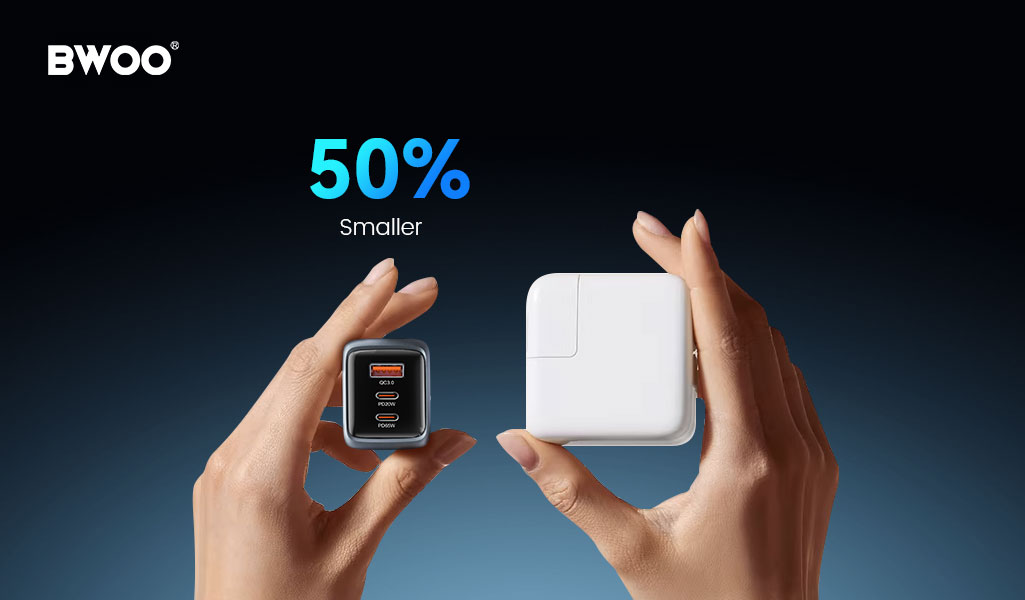
Traditional silicon-based chargers are being rapidly phased out by Gallium Nitride (GaN) technology. By 2026, the global GaN charger market is expected to exceed USD 1.5 billion, with major smartphone and laptop brands already making GaN their default choice.
From a manufacturer's perspective, this shift is not driven by hype. For B2B importers and wholesalers, GaN chargers represent a strategic upgrade—one that improves logistics efficiency, enables premium pricing, and aligns with tightening global compliance requirements. BWOO analyzes why GaN chargers outperform traditional solutions in wholesale and import scenarios.
Why GaN Outperforms Silicon: Technology That Creates Business Value
Higher Power Density: Smaller Size, Greater Output
GaN semiconductors switch up to 20 times faster than silicon, allowing designers to use smaller transformers and inductors.
Result: Chargers deliver higher wattage in significantly smaller enclosures.
Superior Thermal Performance
GaN chargers typically achieve over 90% energy conversion efficiency, generating far less heat during operation.
B2B value: Lower thermal stress translates into fewer failures, reduced return rates, and product lifespans exceeding five years.
Multi-Port Fast Charging Integration
GaN makes it easier to integrate PD fast-charging protocols across multiple ports.
A single GaN charger can safely power laptops, tablets, and smartphones simultaneously—something traditional silicon designs struggle to achieve.
Four Key Business Advantages for B2B Importers
1. Lower Logistics and Warehousing Costs
Calculation logic: GaN chargers are typically 30–50% smaller than equivalent silicon chargers.
Outcome: More units per carton, more cartons per container, and lower shipping cost per unit—directly increasing wholesale margins.
2. Alignment With Global ESG and Energy Regulations
Energy efficiency standards are tightening worldwide, particularly in Europe. Requirements such as ErP Level 6 make low-efficiency products increasingly risky to import.
Why GaN wins: Higher efficiency and lower heat loss reduce carbon footprint and simplify compliance in 2026 and beyond.
3. Stronger Retail Pricing Power and Brand Positioning
End users are willing to pay more for chargers that are compact, cool to the touch, and capable of powering multiple devices.
Importer strategy: Position GaN chargers as a premium line to create a clear price ladder and elevate brand perception.
4. Simplified Inventory and SKU Management
A single 65W or 100W multi-port GaN charger can replace several legacy adapters of different wattages.
Result: Fewer SKUs, lower inventory risk, and easier forecasting for wholesalers.
2026 GaN Sourcing Checklist: Avoid Costly Mistakes
Based on industry experience, BWOO recommends importers verify the following before selecting a supplier:
Certification Coverage: CE, FCC, UL, RoHS, PSE—not partial, but complete and traceable
Safety Architecture: Over-voltage, over-current, over-temperature, and short-circuit protection are non-negotiable
Material Standards: Enclosures should meet 94V-0 flame-retardant requirements to ensure transport and consumer safety
BWOO: Your Strategic GaN Manufacturing Partner
Proven R&D Capability
With over 20 years of manufacturing experience, BWOO offers a full GaN portfolio from 20W to 240W, engineered for the 2026 market.
Flexible Customization
Low MOQ options for housing design, logo branding, and packaging help importers and distributors enter new markets quickly and efficiently.
Reliable Global Supply
Production is managed under ISO 9001-certified systems, ensuring consistency and reliability for large-scale international orders.
Conclusion
GaN chargers are no longer a premium add-on—they are becoming the industry baseline.
For B2B importers, early adoption is not about following trends, but about securing cost efficiency, compliance readiness, and long-term competitiveness.


