




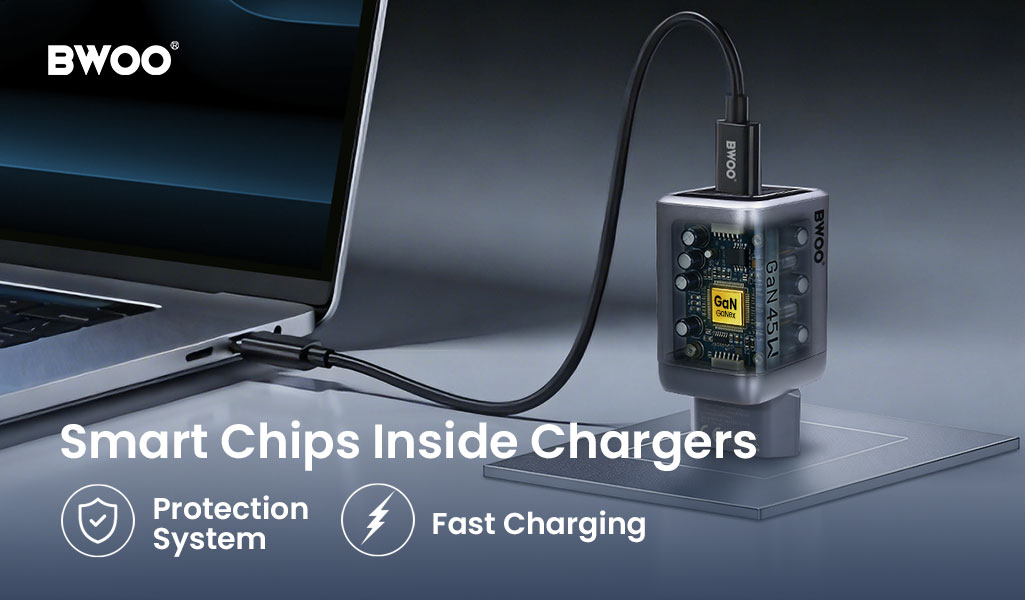
At first glance, many chargers look almost identical. Yet one may cost just $1, while another sells for $15 or more.
The difference is not the plastic shell or the USB port—it is the chipset inside.
From the perspective of a professional manufacturer, this article explains what charger chips actually do, why they are essential for fast charging and safety, and why serious brands are willing to pay more for them.
The Core Role of a Charger Chip: What Is It Really Doing?
A modern charger is no longer a simple power adapter. It is a small power management system, and the chip is its brain.
1. "Handshake Protocols": The Secret Code of Fast Charging
How it works:
Fast charging standards such as USB Power Delivery (PD), Quick Charge (QC), and PPS require real-time communication between the charger and the device.
The chip negotiates with the phone or laptop:
"I can deliver up to 65W. What voltage and current can you safely accept?"
Why it matters:
Without this negotiation, the charger defaults to basic 5W output, even if it claims high power.
A proper protocol chip ensures both sides are "on the same channel," enabling true fast charging, not marketing numbers.
2. Intelligent Current Regulation: Protecting the Battery from 0% to 100%
Why charging slows down after 80%:
Lithium batteries charge quickly at low levels, but become sensitive as they approach full capacity.
The chip dynamically adjusts voltage and current—switching from fast charging to trickle charging.
The benefit:
Prevents overcharging
Reduces heat buildup
Significantly extends battery lifespan
This process is automatic and continuous, controlled entirely by the charger's internal chip.
3. Five-Layer Safety Protection: An Invisible Bulletproof Vest
High-quality charger chips integrate multiple protection mechanisms:
Over-voltage protection: Cuts power instantly if grid voltage spikes
Over-current protection: Prevents excessive current flow
Short-circuit protection: Stops output in abnormal conditions
Over-temperature protection: Monitors internal heat in real time
Surge protection: Shields devices from unstable power environments
These functions operate in milliseconds and are required for international safety compliance.
4. Multi-Port Power Distribution: Smart Load Balancing
When multiple devices are connected, the chip decides how power is shared.
Example:
Laptop: 45W
Smartphone: 20W
Why it matters:
Without intelligent allocation, total output may exceed safe limits—leading to overheating or permanent charger failure.
The Risks of Chargers Without Proper Chips
Cheap or poorly designed chargers often lack real power management chips. The risks are not theoretical—they are common.
1. Damaged Motherboards: The Most Expensive Lesson
Low-quality chargers may deliver unstable or excessive voltage directly into the device.
Sensitive components on the phone's mainboard can be permanently damaged, with repair costs sometimes higher than the phone itself.
2. Ghost Touch and System Crashes: Electrical Noise Problems
Without proper filtering and regulation chips, output current contains heavy ripple and interference.
Common symptoms include:
Unresponsive or "jumping" touchscreens
Random shutdowns
System freezes during charging
These issues are often misattributed to the phone, not the charger.
3. Fire Hazards: The Hidden Cost of Cheap Power
Chargers without thermal control chips cannot manage heat under continuous high load.
Combined with low-grade plastic housings, this creates a real fire risk, especially in overnight charging scenarios.
B2B Purchasing Logic: Why Paying for Chips Makes Sense
For distributors, retailers, and brand owners, charger chips are not an optional upgrade—they are risk management tools.
1. Brand Reputation Risk
Selling 1,000 low-quality chargers may result in hundreds of returns, negative reviews, and long-term brand damage.
2. Regulatory Compliance
Certifications such as CE, FCC, and RoHS require verified protection circuits.
Without proper chips, passing compliance testing is nearly impossible.
3. Long-Term Value
Chargers using premium solutions—such as Navitas GaN chips or Power Integrations (PI) controllers—command higher prices but deliver:
Stronger brand trust
Lower after-sales costs
Higher customer retention
Inside BWOO Chargers: Every Watt Is Calculated
As a manufacturer specializing in power accessories, BWOO treats the chipset as the foundation, not a cost-saving target.
1. Top-Tier Chip Suppliers
BWOO works exclusively with established chipset brands to ensure:
Full protocol compatibility
Stable fast-charging performance
Reliable safety margins
2. PCBA Design Matters
The chip does not work alone.
Capacitors, resistors, transformers, and thermal layouts are engineered to support the chip's control logic, forming a complete power management system.
3. Tested Under Extreme Conditions
In internal testing, BWOO chargers are exposed to voltage fluctuations and overload scenarios.
The protection system activates in as fast as 0.01 seconds, preventing damage before it occurs.
Conclusion: Power Is Not Just About Watts
Choosing a charger is not only about output numbers.
It is about control, communication, and protection.
Saving a few dollars on a charger may put an expensive smartphone, tablet, or laptop at serious risk.
A well-designed chip ensures every watt is delivered safely, efficiently, and intelligently.
When choosing a charger, look beyond power ratings—look inside the chip.
BWOO adheres to the philosophy of serving its customers and will only provide safe and intelligent chargers.
Related readings:
Does a Longer Charging Cable Mean Slower Charging Speed?
A Deep Analysis: Main Charging Cable Materials on the Market


