






Early smartwatches relied heavily on LCD or TFT displays. They were affordable, but the drawbacks were obvious: washed-out colors, poor outdoor visibility, and high power consumption. In daily use—especially under sunlight—important data like time, heart rate, or step count often became hard to read.
By 2026, this situation has fundamentally changed. AMOLED is no longer reserved for flagship models—it has become the new baseline. At BWOO, all newly developed smartwatch models have fully adopted AMOLED displays. This shift is not about following trends, but about choosing the screen technology that truly fits how smartwatches are used. In this article, we break down what AMOLED is and why it has become the ideal display solution for modern smartwatches.
What Is AMOLED?
AMOLED stands for Active-Matrix Organic Light-Emitting Diode. Unlike traditional LCD panels, AMOLED displays do not rely on a separate backlight.
Key differences compared to LCD:
Self-emissive pixels: Each pixel produces its own light and can be individually turned on or off.
No backlight layer: Eliminating the backlight makes the display thinner and more energy-efficient.
This structural difference is the foundation behind AMOLED's advantages in power consumption, contrast, and design flexibility.
Why AMOLED Is the Perfect Match for Smartwatches
1. Power Efficiency: The Foundation of Always-On Display
One of the most important features of modern smartwatches is Always-On Display (AOD).
How it works:
When AMOLED displays black pixels, those pixels are completely turned off, consuming almost no power.
Why it matters:
A BWOO smartwatch can continuously display the time and essential information without significantly reducing battery life. With LCD screens, AOD would drain power rapidly—making it impractical for daily use.
2. Superior Outdoor Visibility: High Contrast and Brightness
Common problem:
Reading the screen during outdoor activities, workouts, or under direct sunlight.
AMOLED advantage:
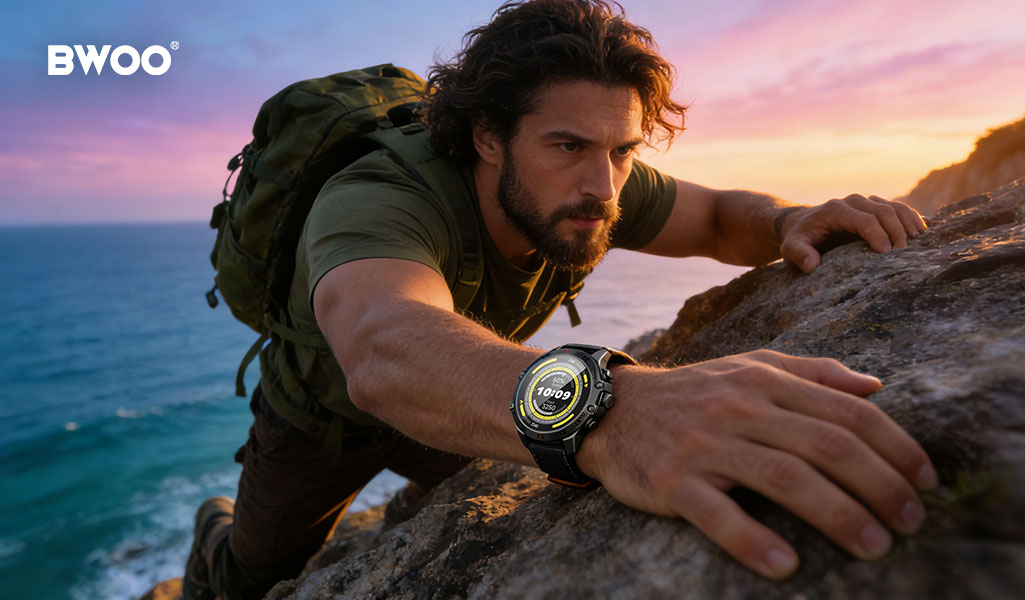
With contrast ratios exceeding 100,000:1, blacks are truly black and colors remain vivid. Combined with BWOO's optimized brightness tuning (up to 1000 nits peak brightness), AMOLED displays remain sharp and readable even in strong sunlight.
3. Thinner Design, Better Wearability
By removing the backlight module, AMOLED panels significantly reduce overall screen thickness.
Design benefits:
Slimmer watch bodies
More internal space for batteries and health sensors
Improved comfort for long-term wear
This allows manufacturers like BWOO to balance elegant design with functional performance—without compromising battery capacity.
What to Look for in a High-Quality AMOLED Smartwatch Display in 2026
Not all AMOLED screens deliver the same experience. When evaluating smartwatch displays, these specifications matter:
PPI (Pixel Density):
A minimum of 326 PPI ensures a "retina-level" viewing experience with no visible pixel grain.
Refresh Rate:
A 60Hz refresh rate provides smoother animations and more responsive interactions. BWOO's 2026 smartwatch lineup fully supports this standard.
Color Gamut:
Displays covering 100% DCI-P3 offer richer, more accurate colors—especially important for fitness data, maps, and notifications.
Conclusion
The display defines the first impression of any smartwatch. AMOLED delivers better battery efficiency, clearer outdoor visibility, and more refined industrial design—all essential for how smartwatches are actually used.
As the industry moves into 2026, AMOLED is no longer a premium feature—it is the standard. For manufacturers, wholesalers, and end users alike, choosing AMOLED means choosing longer battery life, better usability, and a more polished product experience.


