



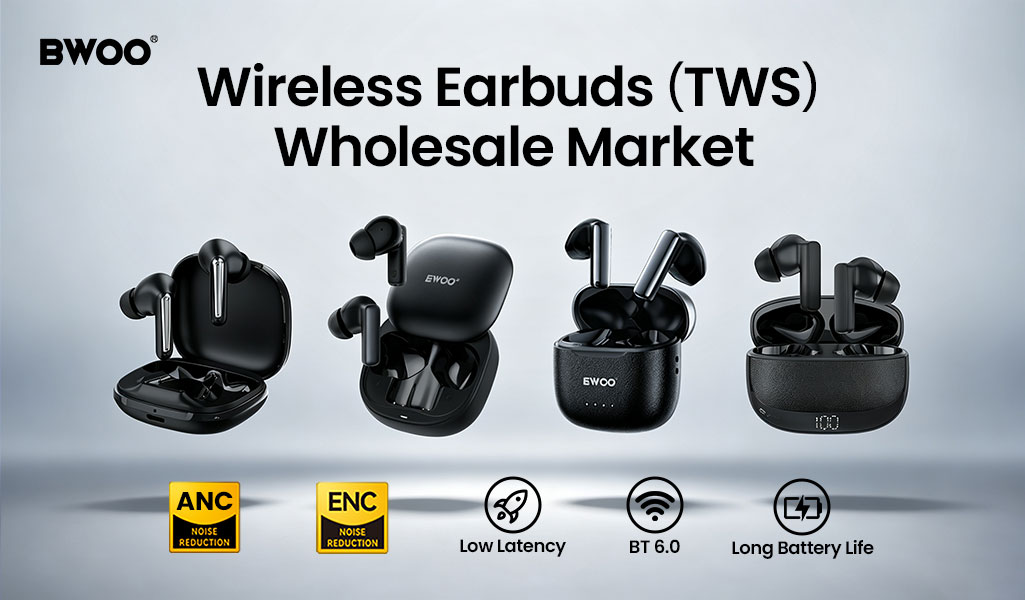
The wireless earbuds wholesale market remains one of the most dynamic categories in consumer electronics. As TWS earphones supplier capacity matures, the competitive battleground has shifted from simple wire-cutting to feature depth: ANC, ENC, low-latency gaming, and all-day battery life. Retailers who understand which features actually drive purchase decisions — and which add cost without adding value — will build the most profitable TWS assortment.
TWS Market Growth and Consumer Behavior
Global TWS shipments continue to climb, driven by a combination of first-time buyers in emerging markets and replacement buyers in mature markets. The category has bifurcated into two clear tiers: entry-level ($8-15 FOB) focused on battery life and basic calling, and mid-to-premium ($15-40 FOB) where ANC, ENC, and low-latency features justify the premium.
What Actually Drives Purchase Decisions
Consumer research consistently ranks battery life and call clarity as the top two purchase drivers, ahead of sound quality. This means ENC — which filters background noise during phone calls — often matters more than raw audio performance. ANC becomes decisive in the mid-tier, where buyers expect to block ambient noise on commutes and flights. Retailers should weight these two features heavily in their assortment decisions.
Emerging Buying Segments
Gamers prioritize low-latency mode (<60ms) and are willing to pay a premium for it. Fitness users demand IPX5+ water resistance and secure fit. Business users care most about call quality (ENC) and multipoint connectivity. A single SKU cannot serve all three — smart retailers stock a matrix that covers each segment at one price point.
High-Demand Feature Checklist
The table below maps the must-have features for a competitive 2026 TWS assortment, with the BWOO models that deliver each.
Features | Entry-Level Standard | Value Segment | BWOO Models |
ANC Active Noise Cancellation | ≥35dB Depth | Mid-to-High-End | BW52/BW591 |
ENC Call Noise Cancellation | ≥4 Microphone Array | All Segments | BW41/BW99 |
Low Latency Game Mode | <60ms | Mid-Range | BW52/BW591 |
Total Battery Life | ≥30h (including charging case) | All Segments | BW41/BW99 |
Waterproof Rating | IPX5+ | Sports/Daily Use | BW52 |
BT Version | 5.3/5.4 | All Segments | All Models |
B2B Selection Strategy for TWS
Stock a Feature Matrix, Not a Single Hero
The highest-ROI approach is a three-SKU matrix: one entry model with ENC + long battery, one mid model adding ANC + low-latency, and one premium model with dual-device multipoint and adaptive ANC. This lets retailers capture price-sensitive, mainstream, and premium buyers without cannibalizing their own lines.
Prioritize Call Clarity Over Spec Bragging
Many TWS listings tout driver size and frequency response, but real-world returns are driven by call quality and connectivity stability. When evaluating samples, test ENC in a noisy environment and check for audio dropouts in crowded RF conditions — these are the failure points that generate returns.
Certification and Firmware Support
Choose a supplier that provides CE/FCC/UKCA certification and OTA firmware support. Firmware updates fix connectivity bugs and add features post-sale, which reduces long-term return rates.
Battery Life Engineering: Beyond the Spec Sheet
The 55-hour battery life advertised on many TWS listings refers to total playtime including recharges from the case, not a single continuous session. Actual per-charge playtime is typically 5-8 hours, with the case providing 4-6 additional charges. When sourcing, clarify both numbers: single-charge playtime and total with case. This distinction prevents misleading marketing that drives returns.
Charging Case Design Matters
The charging case is not just a storage box — it is a second product the customer interacts with daily. Type-C case charging, wireless case charging, and battery level indicators all add perceived value. A slim, pocketable case with a quality hinge mechanism reduces breakage, while magnetic lid closure adds premium feel at minimal cost.
Regional Market Differences
TWS demand varies sharply by region. North America and Europe prioritize ANC, ENC, and brand trust — buyers here will pay $30-60 retail for feature-rich models. Southeast Asia and India are highly price-sensitive, with $10-20 retail models dominating and battery life mattering more than ANC. Latin America and the Middle East sit in between, favoring mid-tier models with strong calling features. Tailor your assortment to each region's value hierarchy.
Marketing and Retail Positioning
How you position TWS earbuds on the shelf determines your sell-through as much as the hardware itself. Feature-led packaging — clear callouts for ANC depth, ENC mic count, and total battery — converts better than vague lifestyle imagery. For online channels, comparison tables and real-use photos (commute, gym, video call) consistently outperform studio product shots.
Pricing laddering matters too. Place your entry ENC model at the impulse-buy price point, your ANC + ENC mid model at the volume price, and your adaptive ANC premium model as the anchor that makes the mid tier look like the smart choice. This classic three-tier anchor strategy maximizes total revenue while protecting margins.
Warranty and After-Sales
TWS earbuds carry higher return rates than most accessories because they are personal-wear items with firmware and battery components. Negotiate a 1% defect allowance and a clear warranty replacement policy (typically 12 months) with your supplier. A supplier who provides spare charging cases and tips as accessories adds another revenue stream while improving customer satisfaction.
Tracking return reasons is the single most underrated improvement loop in TWS retail. When you see a pattern — fit complaints, call quality issues, battery drain — feed it back to your supplier. A responsive supplier can adjust tip kits, firmware, or battery firmware in the next production run, steadily driving returns down. BWOO's account teams actively collect and act on this channel feedback.
FAQ
Q1: What is the most important TWS feature for retail success?
Call clarity (ENC) and battery life consistently outrank raw audio specs in driving satisfaction and reducing returns.
Q2: What is a good entry-level TWS MOQ?
100-500 units. BWOO offers from 100 units with full OEM/ODM support.
Q3: Should I stock ANC or non-ANC earbuds for budget segments?
Stock a mix. ENC is essential at all tiers; add ANC only in the mid-tier where buyers expect it and will pay for it.
Q4: What BT version should I require?
5.3 or newer for lower power draw, better stability, and future-proofing.
Build a TWS assortment that sells through. Contact Us for BWOO TWS samples, feature sheets, and wholesale pricing.


