




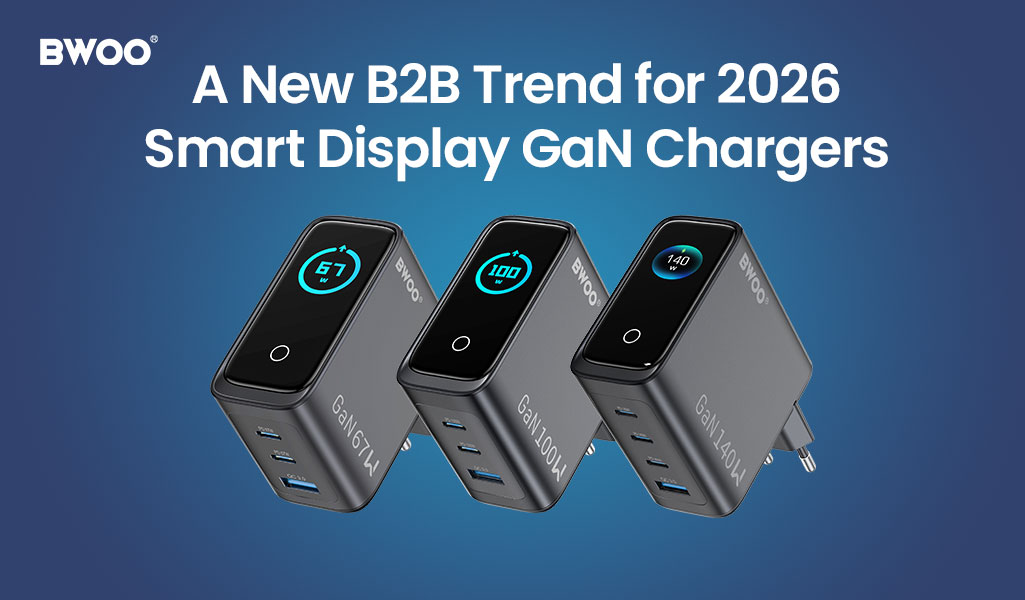
The charger market is quietly going through a visual revolution. After years of black bricks and anonymous ports, smart display GaN chargers are turning a once-boring accessory into a conversation starter: a small screen on the front of the charger that shows real-time output wattage, temperature, and charging protocol. For B2B buyers and private-label brands, this is not just a novelty feature — it is becoming a decisive purchasing factor in 2026. Display-equipped charging products are projected to grow at a 18.6% compound annual growth rate, with the segment expected to exceed $1.45 billion by 2026, according to published market research on smart power delivery displays. Global brands such as Anker (140W Smart Display) and UGREEN have already shipped display-equipped models, signaling that the feature has moved from gimmick to mainstream expectation.
Why Smart Display Chargers Are Gaining Momentum
From Blind Charging to Visible Power Delivery
Traditional chargers give users almost no feedback. You plug in a phone, and you have no idea whether it is negotiating fast charging, how many watts are actually flowing, or whether the temperature is climbing to unsafe levels. A smart display changes this relationship. When a buyer sees a phone jump to 40W, 67W, or 140W on the screen, the charger proves its capability in real time. For resellers and distributors, this visible confirmation is a powerful selling point at retail, and it also reduces post-sale confusion about whether a device is truly fast charging.
Verification, Trust, and Fewer Returns
One of the most expensive problems in the power-accessory category is returns caused by doubt. Customers return chargers because they suspect the output is weaker than advertised, or because they cannot tell whether the unit is genuine. A display removes much of that doubt by showing live wattage and protocol. Our field data from channel partners suggests that products with visible power readouts see meaningfully lower return rates in the accessory category, because the proof of performance is right on the device.
Protocol Recognition as a Feature
Modern smart displays do more than show numbers — they recognize the charging protocol being negotiated, such as PD 3.1, QC, or PPS. This turns a charger into a diagnostic tool. A customer who sees “PD 3.1 140W” on the screen instantly understands which standard is active. For B2B buyers, this protocol visibility is a quality signal that helps justify a higher price point in catalogs and storefronts.
GaN Fundamentals Every B2B Buyer Should Know
Gallium nitride (GaN) is the semiconductor material that makes compact, high-power chargers possible. Compared with older silicon-based designs, GaN offers three structural advantages that directly benefit B2B product lines:
Higher efficiency: GaN transistors switch faster and waste less energy as heat, which matters for 100W+ multi-port output where thermal performance is a real constraint.
Smaller size: A 67W GaN charger can be roughly the size of a traditional 30W silicon charger, enabling the slim, travel-friendly form factors that retailers prefer.
Better thermal behavior: Lower switching losses mean cooler operation, which improves reliability and extends product life in daily-use scenarios.
None of this is marketing fluff — efficiency and thermal data are measurable in the datasheet, and serious B2B sourcing should always request them.
Multi-Port Output and Smart Power Allocation
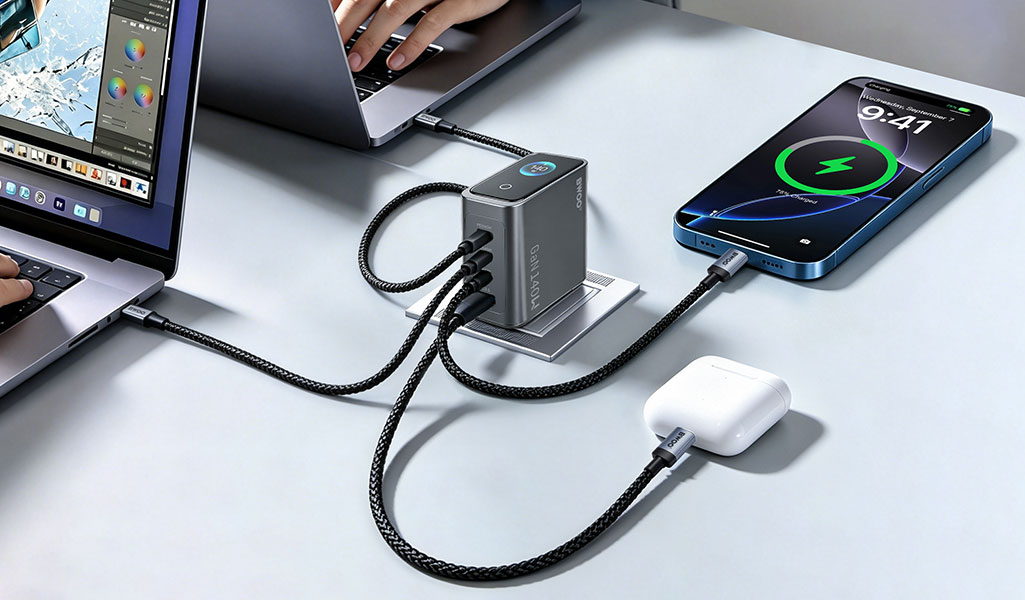
The real engineering challenge of a modern charger is not raw wattage; it is how the power is shared when multiple devices are plugged in simultaneously. A well-designed smart display charger handles this gracefully with intelligent power allocation. For example, a 67W three-port unit can output 65W on a single USB-C port for a laptop, and rebalance automatically when a phone and earbuds join the session. A 140W four-port unit adds headroom for heavier multi-device workflows — charging a laptop, tablet, phone, and earbuds at the same time.
This matters for B2B buyers because power allocation logic is where cheap chargers cut corners. In low-quality units, adding a second device can cause the first port to drop to a trickle or, worse, the charger can overheat under sustained load. When evaluating suppliers, ask for the port-by-port output matrix and insist on GaN-based allocation chips that renegotiate smoothly rather than simply splitting current in half.
How B2B Buyers Should Evaluate a Smart Display GaN Charger
Request the Certification Portfolio
For the North American, European, and other regulated markets, certifications are non-negotiable. A reliable factory should provide the relevant safety and EMC marks for each target region. Ask to see certificates before sampling, and verify that the displayed model numbers match the actual units shipped. Certification coverage is one of the fastest ways to separate genuine manufacturers from assemblers.
Validate the Display Components
Not all displays are created equal. TFT and OLED screens differ in brightness, viewing angle, and cost. A quality smart display should remain legible in daylight, update without lag, and not significantly affect standby power consumption. Ask the supplier about the display driver and whether the screen can be customized for your brand — some manufacturers offer custom boot logos and default screens as an OEM option.
Confirm the GaN and Control Chip Source
Component provenance is a strong proxy for reliability. Reputable suppliers can name the GaN power stage and protocol controller vendors they use. If a factory cannot answer this basic question, treat it as a red flag during supplier evaluation.
Check Real-World Thermal Performance
A display charger shows temperature on screen, which means thermal behavior becomes public. Ask for thermal test reports under sustained full-load conditions. A unit that stays cool under 140W continuous load is a different product from one that throttles after twenty minutes.
The BWOO Approach: AI Smart GaN Display Chargers
At BWOO, we build smart display GaN chargers specifically for B2B distribution, private label, and retail resale. Two models anchor our 2026 lineup:
BO-CDA265 — a 67W three-port smart display GaN charger, ideal for phone-plus-laptop daily carry and a strong entry-level display product for distributors.
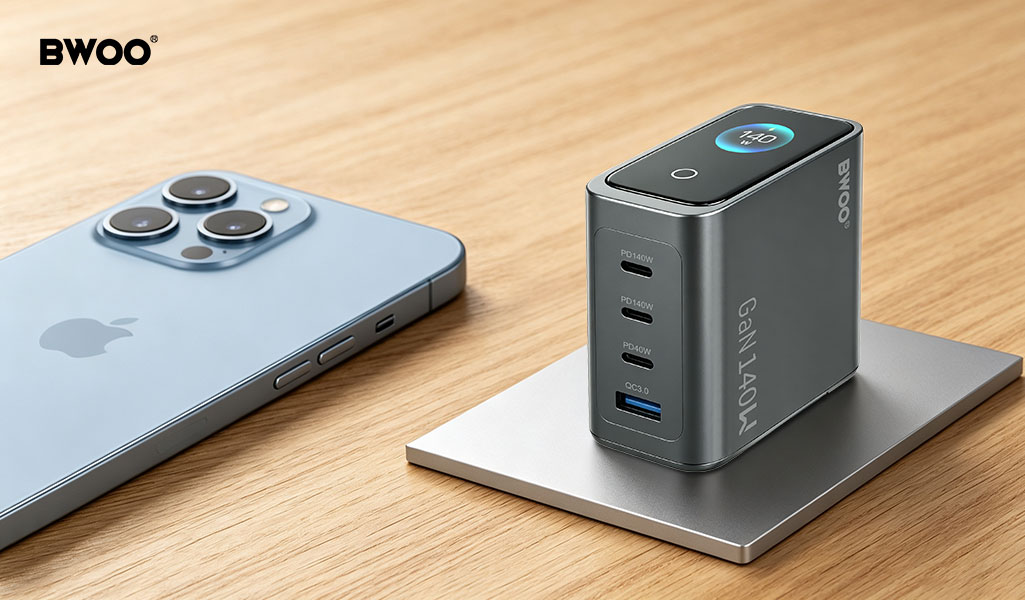
BO-CDA267 — a 140W four-port AI smart display GaN charger that handles full laptop charging, multi-device workflows, and higher-value retail positioning.
Both units display real-time output wattage, temperature, and protocol recognition, and both ship with the certification packages needed for regulated markets. For a full view of the lineup, browse the charger category page and the BO-CDA267 product page. Distributors pairing display chargers with portable productivity setups can also reference our USB-C hub sourcing guide to build a complete desk setup bundle.
Why 2026 Is the Right Window for B2B Buyers
The smart display charger category sits at a favorable point in the adoption curve. Major brands have validated the concept and educated consumers, but the segment has not yet been commoditized, which means margins remain healthier than for plain GaN bricks. For distributors and brands entering now, the window offers a chance to differentiate on feature and storytelling before the market saturates.
At the same time, B2B buyers should be realistic about costs. Display components add to the bill of materials, so smart display units carry a higher unit price than equivalent non-display models. That premium is justified at retail when positioned as a “premium, verifiable charging experience,” but it requires the right merchandising strategy — which is exactly why testing sell-through on a pilot SKU before a full-scale order is a prudent approach.
Frequently Asked Questions
Q1: Is a smart display GaN charger worth the extra cost compared with a regular GaN charger?
A: For most B2B portfolios, yes. The display adds a visible proof-of-performance feature that supports premium pricing and reduces return-driven doubt. If your channel sells primarily on price, a display model may be a smaller share of the mix; if your channel sells on experience and trust, it can become a flagship SKU. We recommend piloting one display SKU alongside your standard GaN line and comparing sell-through.
Q2: Does the display consume extra power or shorten the charger's lifespan?
A: Negligibly. A well-designed display circuit draws a tiny amount of power only while the charger is connected and typically dims or enters low-power mode when idle. The display components are selected for long service life, and because the screen also shows temperature, users can monitor the unit's thermal health over time.
Q3: What devices can a 140W display charger actually drive?
A: A 140W unit comfortably charges a large laptop at full speed (many flagship laptops need 60–100W), plus a tablet, a phone, and earbuds simultaneously, with smart rebalancing across ports. It is the right choice for road warriors, creative professionals, and multi-device desk setups.
Q4: Which fast-charging protocols do smart display GaN chargers typically support?
A: Mainstream models support PD 3.1 / PD 3.0, PPS, QC 4.0+, and commonly used vendor protocols, so they cover phones, tablets, laptops, and earbuds across major brands. Always request the protocol compatibility matrix from the supplier and confirm it matches your target market's dominant devices.
Start Sourcing Smart Display GaN Chargers for Your Brand
Smart display GaN chargers are a proven differentiator entering its growth phase, and the 2026 window favors buyers who move early with a credible partner. If you are a distributor, retailer, or brand evaluating this category, BWOO offers display GaN chargers, private-label options, and volume pricing. Send an inquiry with your target wattage, port configuration, and certification requirements, and our team will respond with samples, datasheets, and a tailored quotation. Send Inquiry now to start your sourcing conversation.


