






What Is "Step-Down Charging" in Fast Charging?

2026-02-02 13:49
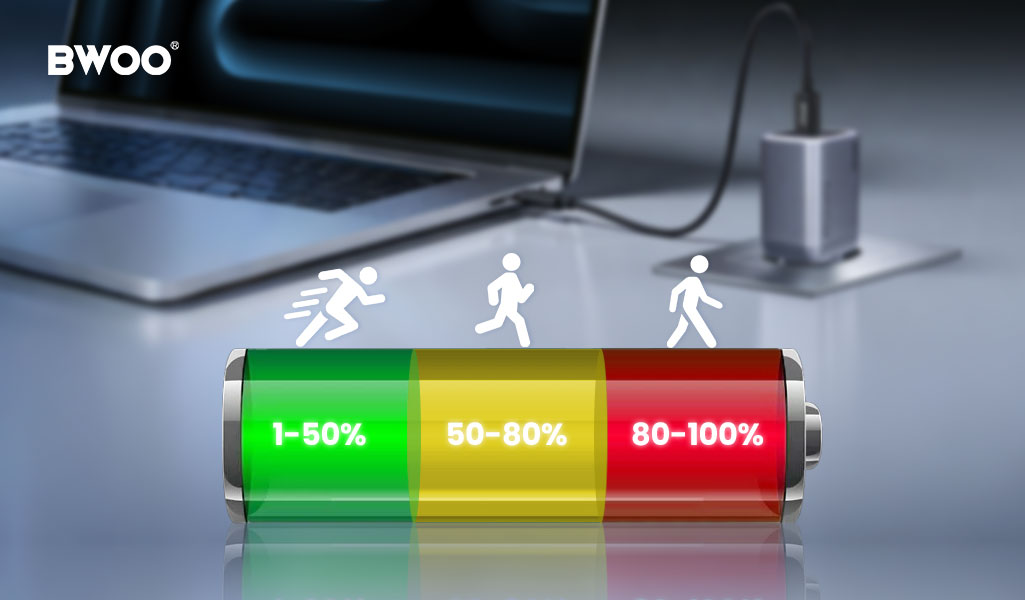
Anyone who uses fast charging has noticed this pattern:
from 1% to 50%, the battery fills up in minutes—but from 80% to 100%, it suddenly feels painfully slow.
Is this a flaw in fast charging technology?
In reality, this behavior follows a deliberate and well-established charging strategy known as step-down charging. This article explains why charging speed slows down by design—and why that slowdown is essential for battery safety and longevity.
How Step-Down Charging Works
The Three Phases of Lithium Battery Charging
Modern lithium batteries do not charge at a constant speed. Instead, they follow a three-stage process:
1. Trickle Charging (Low-Voltage Wake-Up)
When the battery voltage is extremely low, the system applies a small current to safely "wake up" the battery and prevent internal damage.
2. Constant Current Fast Charging
This is the high-speed phase most users associate with fast charging.
The charger delivers maximum allowable current, rapidly increasing battery capacity.
3. Constant Voltage Charging (Step-Down Phase)
Once the battery reaches a high voltage threshold, the system holds voltage steady and gradually reduces current—this is where step-down charging begins.
Why Charging Speed Must Be Reduced in Stages
Thermal Control
High current generates heat. Continuing full-power charging near full capacity would cause excessive temperature rise, accelerating battery aging and triggering thermal protection.
Battery Longevity
Lithium batteries are sensitive to overvoltage. Gradual current reduction protects the chemical structure of the battery and preserves long-term capacity.
Step-down charging is not a limitation—it is a safeguard.
Why the Last 20% Takes the Longest
The "Parking Lot" Effect
Early in charging, the battery is like an empty parking lot—ions can move freely and settle quickly.
Near full capacity, only a few precise spots remain. Each lithium ion must carefully find its place, slowing the overall process.
Rising Internal Resistance
As the battery fills, internal resistance increases. Forcing high current at this stage converts more energy into heat instead of stored charge.
Polarization Effects
Lithium ions temporarily accumulate near electrode surfaces and require time to diffuse evenly. Slowing the charge allows the battery chemistry to stabilize.
Safety and Battery Life: Why Slowing Down Is Essential
Preventing Lithium Plating
If fast charging continues aggressively near 100%, lithium ions may deposit on the anode surface instead of embedding properly.
This phenomenon—known as lithium plating—can form dendrites, increasing the risk of internal short circuits.
The Role of Trickle Charging
The final percentage points refine battery calibration, ensuring that "100%" represents stable and usable capacity—not just a voltage spike.
This careful finishing process is critical for both safety and reliability.
How to Use Fast Charging More Wisely
The 80/20 Rule
When time is limited, charging to around 80% delivers the best balance of speed and efficiency.
Healthier Charging Habits
Avoid treating 100% as a constant goal. Partial, frequent charging is often better for battery health.
Environmental Impact
Extreme temperatures—hot or cold—force step-down charging to begin earlier, further slowing the process.
BWOO's Perspective on Fast Charging Design
As a long-term manufacturer of power accessories, BWOO designs chargers and power solutions in strict alignment with lithium battery charging protocols and international safety standards.
Rather than pushing peak wattage alone, BWOO emphasizes:
Intelligent power management chips
Stable voltage regulation
Controlled thermal performance across the full charging curve
This standards-first approach ensures fast charging remains both efficient and sustainable.
Conclusion
Step-down charging is not a technological compromise—it is respect for physical reality.
The slower final stage exists so your device can perform reliably for years, not just charge quickly today.
The last 20% may test your patience, but it protects your battery's future.


