







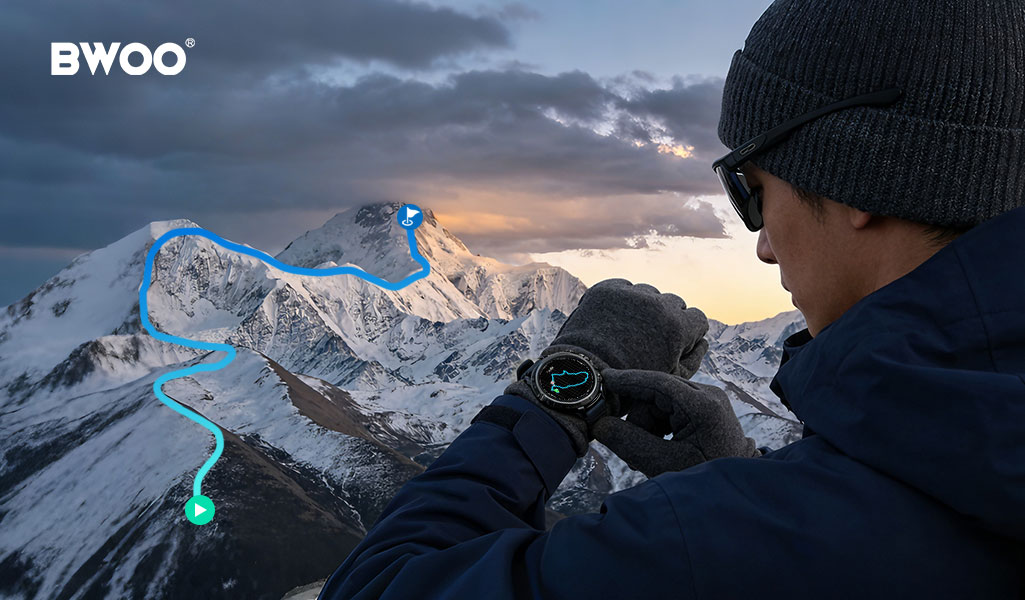
Why Does Your GPS Track Drift in Cities or Forests?
Have you ever gone for a run between skyscrapers, or hiked through dense forest, only to find your smartwatch track drifting off the trail—or losing signal entirely?
This is not a software glitch. It's a limitation of single-band GPS.
In complex environments filled with buildings, trees, and uneven terrain, traditional positioning systems struggle with signal reflection and interference. By 2026, Dual-Band GPS is becoming the gold standard for high-performance smartwatches, especially for outdoor and fitness use.
What Is Dual-Band GPS?
Dual-Band GPS refers to a positioning system that receives two satellite frequency bands simultaneously, instead of relying on just one.
1. L1 Signal (Traditional Band)
The most commonly used GPS frequency
Fast acquisition and low power consumption
Highly vulnerable to multipath interference when signals bounce off buildings, walls, or trees
2. L5 Signal (Advanced Band)
Higher frequency and wider bandwidth
Stronger resistance to interference
More accurate timing and better signal integrity
How They Work Together
A dual-band GPS smartwatch receives both L1 and L5 signals at the same time.
The positioning chip compares data from both bands, automatically filtering out reflected or delayed signals and keeping only the most reliable path data.
The result is far more accurate and stable positioning, especially in challenging environments.
Why Dual-Band GPS Makes a Real Difference on Smartwatches
1. Accuracy in Urban "Canyons"
The problem:
Tall buildings block and reflect satellite signals, causing sudden jumps in recorded routes during city runs or commutes.
The value:
Dual-band GPS corrects timing errors caused by reflections, delivering precise location data even among dense concrete structures.
2. Safety in Outdoor and Wilderness Scenarios
The problem:
In mountains, forests, or valleys, single-band signals weaken and drift easily—raising the risk of navigation errors.
The value:
The L5 band's stronger penetration ensures more reliable positioning, helping users stay on track in remote or rugged environments.
3. Faster Satellite Lock (TTFF)
The value:
Dual-band chips can acquire satellites more quickly, reducing the time-to-first-fix (TTFF).
That means less waiting on the roadside or trailhead and more time moving.
What Defines a High-End GPS Smartwatch in 2026?
Dual-band GPS is only one part of the equation. In 2026, advanced positioning performance also depends on:
1. Full GNSS Constellation Support
Beyond GPS, does the watch support Beidou, Galileo, and GLONASS?
Multi-constellation reception improves availability and accuracy worldwide.
2. Smart Battery Management
Dual-band positioning consumes more power.
Leading smartwatches use adaptive algorithms to balance precision and battery life, switching modes based on movement and environment.
3. Offline Maps and Navigation
Accurate positioning reaches its full potential when paired with offline maps, making smartwatches true outdoor navigation tools rather than basic trackers.
Conclusion
Dual-Band GPS is more than a specification on a data sheet.
It is a digital guide designed for complex, real-world environments—where buildings, trees, and terrain challenge traditional positioning systems.
For runners, hikers, cyclists, and outdoor explorers, dual-band GPS represents a meaningful leap in accuracy, reliability, and confidence.


