




The Hidden Cost Behind “You Get What You Pay For”
Many consumers think nothing of spending $1,000 on a smartphone, yet hesitate to spend more than a dollar or two on a charger. From a psychological perspective, chargers are often viewed as “accessories” — interchangeable, simple, and unworthy of investment.
The market reinforces this mindset. White-label and unbranded chargers flood online marketplaces and wholesale channels, often priced far below certified alternatives. On the surface, they appear to work: the phone charges, the battery icon fills up, and life goes on.
However, the real cost is hidden. What users save at checkout is often paid back through accelerated battery degradation, damaged power management circuits, and in extreme cases, serious safety incidents. A charger is not just a power source — it is an electrical system directly connected to one of the most sensitive components in a smartphone: the lithium battery.
Killer #1: Unstable “Dirty Power” — Understanding Ripple Current
A simple analogy:
Your phone battery needs clean drinking water. A cheap charger delivers muddy water filled with sand.
What Is Ripple Current?
Ripple refers to residual AC fluctuations that remain after AC power is converted to DC. In high-quality chargers, ripple is minimized through proper circuit design and high-grade filtering capacitors. In cheap chargers, ripple is often ignored.
To reduce cost, manufacturers commonly:
Use undersized or low-quality electrolytic capacitors
Skip secondary-stage filtering
Accept ripple levels far above industry-recommended thresholds
Why Ripple Is Dangerous
Excessive ripple causes continuous voltage fluctuations at the battery input, leading to:
Micro short circuits inside the battery: Repeated electrical stress damages internal lithium-ion structures over time.
Power management chip fatigue: The phone’s PMIC must constantly compensate for unstable input, accelerating wear and increasing the risk of chip failure.
The result is not immediate failure, but gradual and irreversible battery health loss.
Killer #2: Uncontrolled Heat — Efficiency and Thermal Management
According to basic physics, lower efficiency equals higher heat generation.
Why Cheap Chargers Overheat
To cut costs, low-end chargers often rely on:
High-resistance components
Poor thermal conductivity materials
Minimal or no internal heat dissipation design
This creates two layers of damage.
Double Impact on Your Phone
1. Heat Transfer to the Device
Overheating chargers can transmit heat through the cable and connector, stressing the phone’s charging port and internal components.
2. Accelerated Battery Aging
Lithium batteries are extremely sensitive to temperature. Long-term charging above 45°C can reduce battery capacity by up to 20% in just three months, even if the phone is brand new.
This degradation is permanent.
Killer #3: Blind Power Delivery — No Charging Protocol Intelligence
Modern smartphones rely on communication protocols (such as PD or proprietary fast-charge handshakes) to negotiate safe voltage and current levels.
“Smart” vs. “Blind” Chargers
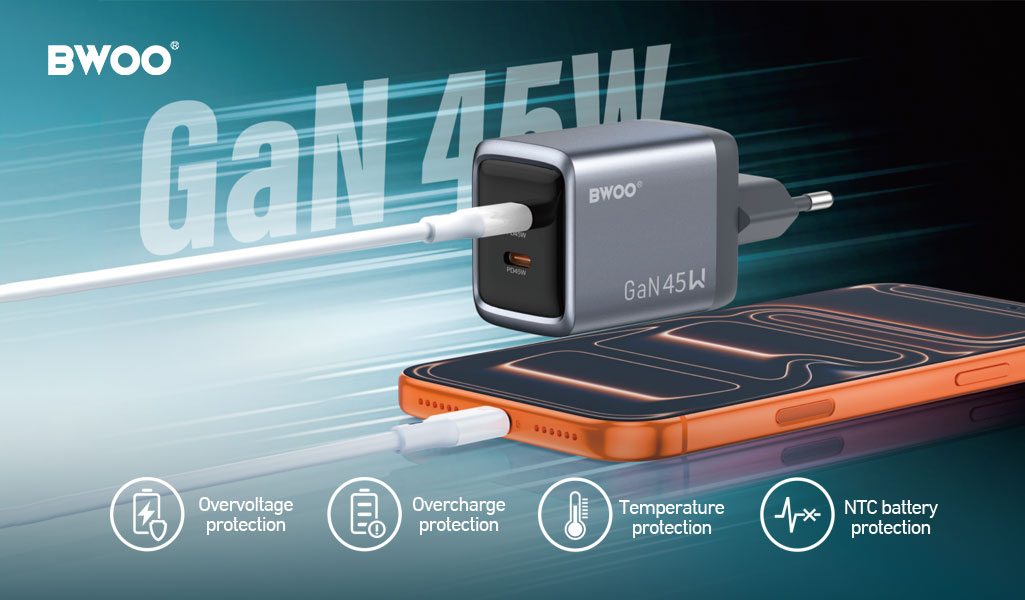
A well-designed charger — like those developed by BWOO — uses intelligent control chips to:
Identify the connected device
Adjust output dynamically
Stop charging when the battery reaches safe saturation
Cheap chargers lack this intelligence. They simply push power without negotiation.
The Risks
Overcharging: Without proper termination logic, batteries remain under stress even after reaching full capacity.
Voltage spikes: Cheap chargers often lack surge protection. During grid fluctuations (e.g., thunderstorms), high voltage can be passed directly to the phone.
This is one of the most common causes of sudden battery failure and motherboard damage.
Inside the Charger: Why Are Cheap Chargers So Cheap?
A teardown reveals the truth.
Inferior PCBA Design
Extremely small circuit boards
Crowded layouts with flying wires
Insufficient safety clearance between high- and low-voltage zones
Missing Safety Components
Cost-cutting often means removing:
Fuses
Varistors
Y-capacitors
EMI suppression circuits
Each omitted component increases risk.
Flammable Housing Materials
Many low-cost chargers use non-flame-retardant ABS plastics. In the event of a short circuit, the enclosure itself can become a fuel source.
A B2B Perspective: What Selling Cheap Chargers Really Costs Your Business
For distributors, wholesalers, and retailers, the damage goes beyond hardware.
High Return Rates
Return rates exceeding 10% quickly erase margins — especially in low-priced product categories.
Brand Trust Erosion
Consumers do not separate the charger from the seller. A failed $1 charger can permanently damage trust in your entire product range.
Legal and Compliance Risks
Products lacking CE, FCC, or RoHS certification pose serious risks at customs and with local regulators. Fines, confiscations, and delistings are far more expensive than sourcing compliant products.
Conclusion: Protecting the Battery Means Protecting Your Business
A charger should act as a bodyguard for the phone battery — not a silent killer.
Choosing chargers designed by brands with in-house R&D, strict quality control, and verified certifications is not about luxury. It is about longevity, safety, and reputation.
BWOO approaches charger design from an engineering-first perspective, ensuring stable power delivery, thermal safety, and long-term battery protection — values that matter not only to end users, but to serious B2B partners worldwide.
Related readings:
Single Port vs. Multi-Port Chargers


