



Plug Type Selection — The First Barrier in Cross-Border Electronics Trade
In global consumer electronics trade, plug type selection is often underestimated. Yet in reality, it is one of the first and most critical compliance decisions a buyer must make.
There are more than 15 different power plug and socket standards worldwide. Choosing the wrong plug type can mean:
Products that cannot legally enter the market
Failed compliance inspections
Extremely high return rates due to incompatibility
For buyers targeting mixed regions such as Southeast Asia, the Middle East, or South America, the challenge becomes even more complex:
Which plug types should be stocked, and in what proportion?
This guide provides a systematic breakdown of the world’s main plug standards (US, EU, UK, AU), explaining not only their physical differences, but also the voltage, frequency, and certification logic behind them — helping professional buyers make informed, scalable decisions.
Deep Dive: The Three Major Global Plug Standards
1. US Plug (Type A / Type B)
Technical characteristics
Type A: Two flat parallel pins
Type B: Two flat pins + one round grounding pin
Key markets
United States, Canada, Mexico, Japan, Taiwan, and parts of Southeast Asia.
Voltage & frequency
110V–127V / 60Hz
B2B sourcing considerations
Although Japan uses a US-style plug, there are subtle differences in pin size and polarity standards. Chargers designed only for strict US tolerances may feel loose or incompatible in some Japanese outlets.
BWOO chargers typically adopt wide-tolerance pin design, ensuring stable contact across US and Japan markets while maintaining IEC compliance — a detail that matters for long-term reliability and brand reputation.
2. EU Plug (Type C / E / F)
Technical characteristics
Two round pins
Type C (Europlug): Ungrounded, compact, and the most widely used
Key markets
Germany, France, Italy, Spain, Russia, and parts of South America such as Brazil and Chile.
Voltage & frequency
220V–240V / 50Hz
B2B sourcing considerations
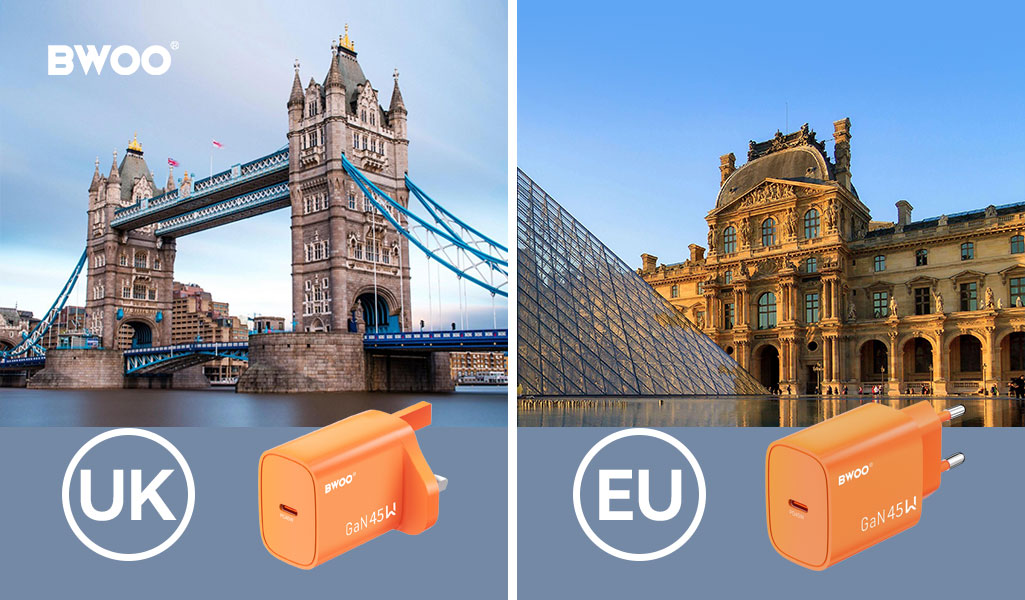
The EU plug family covers the largest number of countries globally, making it the highest-volume plug type in international procurement.
However, buyers should distinguish between:
Europlug (Type C) for low- to mid-power chargers
Type E/F grounded plugs for higher power output or stricter national requirements
BWOO supports both configurations depending on wattage and target certification needs.
3. UK Plug (Type G)
Technical characteristics
Three large rectangular pins arranged in a triangular layout
Key markets
United Kingdom, Hong Kong, Singapore, Malaysia, UAE, Saudi Arabia, and several Middle Eastern countries.
Why is it considered one of the safest plugs in the world?
Built-in fuse inside the plug
Shuttered socket system to prevent accidental contact
Mandatory grounding
B2B sourcing considerations
For high-end markets in the Middle East and Southeast Asia, the UK plug is not optional — it is often a baseline requirement for safety perception and regulatory acceptance.
Often Overlooked Technical Factors: Voltage & Frequency
Why Wide Voltage Matters
A professional-grade charger should support 100V–240V input, allowing it to operate safely worldwide without an external transformer.
All BWOO chargers are designed with wide-voltage input as standard, enabling:
Simplified global SKU management
Reduced logistics complexity
Fewer after-sales issues in mixed-voltage markets
Frequency Differences: 50Hz vs 60Hz
While frequency differences do not affect charging speed directly, they place higher demands on internal components, such as:
Capacitors
Transformers
EMI suppression circuits
Improper frequency handling can reduce lifespan or cause instability. This is why frequency compatibility should be treated as a design-level requirement, not an afterthought.
Certification Mapping by Market
CE / RoHS: Essential for EU compliance
FCC / UL: Safety and electromagnetic compliance for North America
UKCA: Mandatory certification for the UK post-Brexit
Plug type, voltage rating, and certification must align — mismatches are a common reason for customs clearance failures.
Commercial Selection Strategy: How to Configure Inventory by Region
Single-Market Strategy
For buyers supplying a single domestic market (e.g., US or EU retail chains), a 100% dedicated plug configuration ensures cost efficiency and regulatory clarity.
Mixed-Market Strategy (Southeast Asia / Middle East)
Recommended approaches:
60% UK plug + 40% EU plug, depending on country mix
Or offer chargers with certified interchangeable plug adapters
Global Travel Solution
For travel-focused users and premium retail channels, multi-plug interchangeable chargers provide maximum flexibility.
BWOO’s modular plug charger designs allow users to swap plug heads without compromising safety or output performance — a practical solution for frequent travelers and international distributors alike.
Why Choose BWOO as Your Global Charger Supplier?
1. Full Plug Type Coverage
The same charger model (e.g., 20W PD) is available with US, EU, and UK plug molds, ensuring consistent branding across markets.
2. Strict Dimensional Compliance
All plug pins strictly follow IEC standards, reducing risks of loose connections or insertion resistance issues.
3. OEM / ODM Flexibility
BWOO supports country-specific requirements such as:
AU or India plug standards
Local-language packaging
Market-specific certification alignment
This allows buyers to scale globally without redesigning products for each region.
Conclusion: Choose the Right Plug, Connect Global Profit
Understanding global plug standards is a core competency for professional buyers, not just a technical detail.
With the right plug configuration and a reliable manufacturing partner, global expansion becomes faster, safer, and more profitable.
Contact BWOO’s sales team for tailored inventory configuration advice.
Related readings:


